Para Long Mueng Poy Lern Sib ed Ok Wah Lu Chong Kheng Tang Pud or Chong Para
Update 23 August 2023
Visitors 19677 Category Tradition
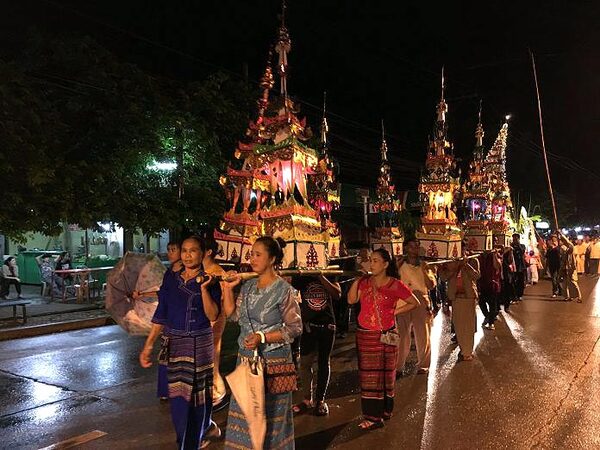
The festival of Para Long Mueng is part of the Buddhist lent festival Poy Lern Sib-ed. Chong Para means monk is castle in the Shan language. As part of the worship of Chong Para the monkis castle is constructed to welcome the Lord Buddha who has descended from the second heaven where Indra resides. This festival is held between the 15th day of the 11th lunar month and the 8th day of the 11th lunar month. Chong Para a temporary castle constructed from bamboo frame is decorated with mulberry paper colorful paper banana shoots sugar canes and lanterns. It is decorated in a manner that gives the impression that it is used to welcome the Lord Buddha from heaven. Upon completion of this process the castle will be placed outside residential areas or the courtyard of temples. The residents of Piangluang District go to temple to make a merit on the 15th day of the waxing moon which marks the end of the Buddhist Lent. Rituals such as Tak Bat Devo are held at some temples. It is customary in the evening for people offer flowers incenses and candles along with glutinous rice steamed in banana leaves as a way of asking for forgiveness from their parents and elder relatives. Prior to the dawn of the first day of the waning month a ritual called Som Tor is performed. As part of the ceremony a small container containing lighted incense is placed in public spaces as an offering to the Tai people who possess a positive influence on the lives of the people. Thousands of lights illuminate temples pagodas and houses at dawn creating an impressive sight.
The end of Buddha lent falls on the day in which the Lord Buddha descended from heaven which is known as Devorohana Day or Prajaopedlok Day which usually takes place in October. Activities include Tak Bat Devo making merit at the temples and listening to the sermon. The Shan temples in Piengluang District will construct a magnificent castle known as Chong Para or Chong Kheng Tang Pud before the evening of the 14th day of the waxing moon. The people will offer fruits grains and agricultural products at Chong Para which will be used as a residence for the Lord Buddha when he descends from heaven on the 15th day of the waxing moon of the 11th lunar month (Phramaha Krisorn Kanlayataro 2021).
A ritual of offering Som Tor is observed at Chong Para since 4 a.m. in Viharas Chedis and spiritual houses along with offering alms. Thereafter the Lord Buddha is offered a large Som Tor and Chong Para. The villagers attend the sermons at the temples and donate offerings.
Villagers are asked to seek forgiveness and blessings from the elderly and the respectful in the village (Kantor). It is expected that young members of descent who reside far away will attend the ritual. During the evening people will perform the bird dance the Toh dance as well as offer Lutontenpek (candle holders made from pine trees) Tenkab (lanterns made from lotus leaves) and float lanterns (Phramaha Krisorn Kanlayataro 2021).
According to Shan belief once the Buddha descends from heaven Himmapan creatures such as mystical birds (Kinnon and Kinnaree) and Toh (Yak) sing and perform for the Buddha. The performance continues to be performed to this day. There was no power during the Buddhais era so the disciples had to light a fire to illuminate the darkness. Tontenpak is then made by the Shan people as an offering to the Buddha. As deities accompanied the Lord Buddha from heaven the light from the lantern illuminated the night sky. It is therefore believed that the lantern light represents the radiance of the deities (Phramaha Krisorn Kanlayataro 2021).
Map
Source : travel.kapook.com
Temples
- Lisu New Year (19893)
- Wat Fa Wiang Inn (19715)
- Para Long Mueng Poy Lern Sib ed Ok Wah Lu Chong Kheng Tang Pud or Chong Para (19677)
- Kinwa KhaoJawe and Lahu New Year Festivals (19661)
- Chinese New Year (19523)
- Poy Sang Long (19502)
- Poy Pee Mai Tai (19469)
- Poy Khao Wa (Buddha Lent) (19454)
- Wat Huai Krai or Huai Krai Temple (19422)
- Poy Ja Ka (19398)