Lisu New Year
Update 24 August 2023
Visitors 19897 Category Tradition
Based on Dooasia (2007) Lisu New Year falls on Chinese
New Year. There are a number of activities and rituals associated with the Lisu
new year including the following.
Glutinous rice steaming - Pook rice is steamed in the morning before it is pounded. Once the sticky rice has been cooked pound it until it is soft and sprinkle flour or sesame seeds over the sticky rice to prevent it from sticking to your hands and form it into moderate cubes. Roll the banana leaf back and forth to embed it in the prepared banana leaf.
On the evening of the day prior to Pa Tia day the Ko Xei
and Zho trees must be prepared. Ideally the trees should have beautiful foliage
slender trunks and a height of about 1.5 meters. The chosen trees were planted
in the courtyard of the house then Papa as well as pork called Sashi was cut to
about 6-7 inches long and was hung on the pole with two incense sticks lit. In
addition boiled eggs and long threads are prepared that can be tied around the
neck or wrist of each household member. During the invocation ceremony the
elder of the house (usually a man) removes all the boiled eggs and the yarn
that will be used to bind the cup of cooked rice placed on another layer of
cloth. Upon completion of the ceremony the holy thread was tied and boiled eggs
were given to each member. The purpose of this was to allow the spirit of the
owner who may have escaped from his body to return to it.
The purpose of establishing Kho Xue and Zhou is to invite
female deities to descend to bless the homeowner. One time a year the deities
will come down to visit on the morning of the first day of the New Year.
Consequently it is necessary to clean the house before this god arrives. There
is also the belief that if a house is dirty it will not receive blessings.
Traditionally it is used as a place for people to dance around to celebrate the
new year and drive evil from their household.
The first day of the festival every household is expected
to wake up early and prepare equipment for paying homage to the ancestral
spirits and the gods Apa Mou. A male
representative from each household is required to attend the ceremony along
with a pair of rice bowls a bottle of liquor and a piece of pork for blessings
from Apa Mou a deity who protects the villagers. In the late morning the
equipment will be prepared for paying respect to the elderly and for seeking blessings
from Mue Mu who has led the ritual throughout the past year. There will also be
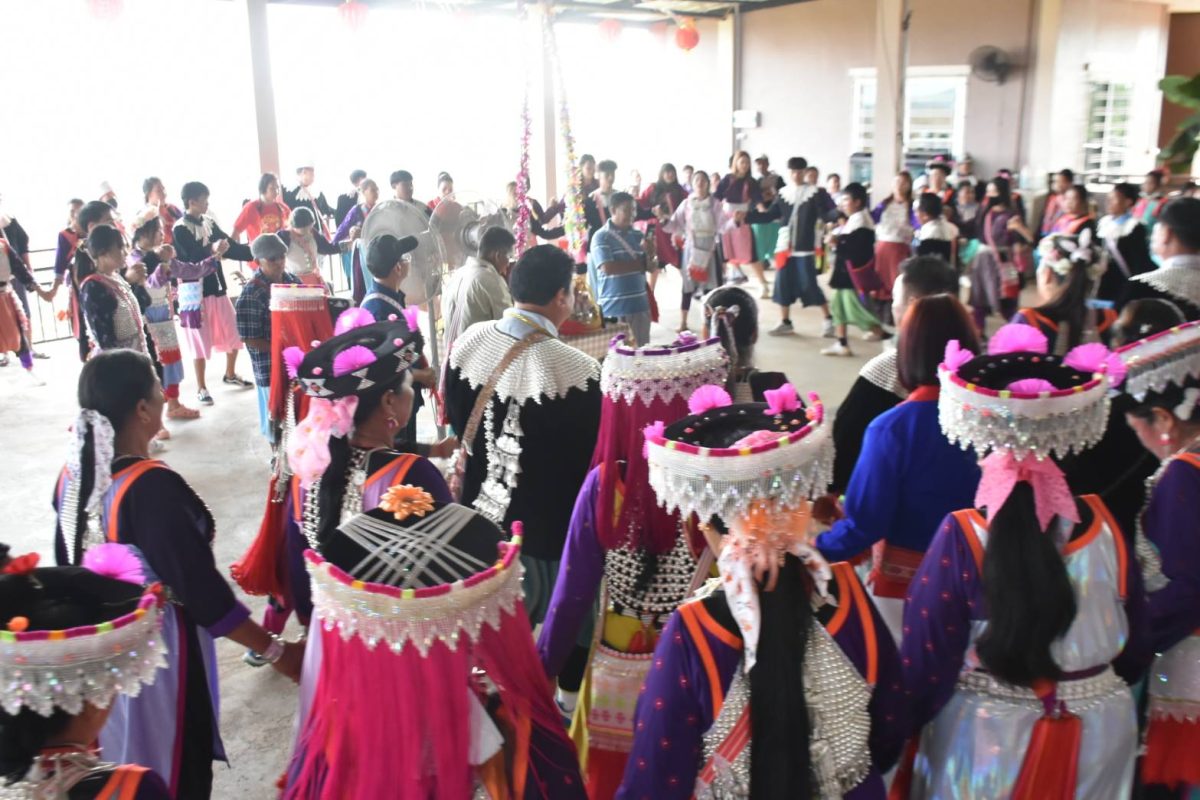
dances and songs performed by young people dressed in tribal outfits and
wearing beautiful jewelry. As a celebration and welcome to the new year a dance
was performed around every house as well as to bless and wish the owner of the
house good luck. In gratitude for the blessing your host will provide snacks
tea and liquor.
On the second day the villagers will participate in the
ceremony of paying respect to the elderly. In appreciation of the community
leaders for their protection and leadership so that the people in the community
may live happily throughout the year. There will be similar rituals and
activities to those associated with Mue
Mu however there will be no Kho Xia Chua.
On the third day the villagers will proceed to the shrine area in the morning in order to receive blessings from the gods who protect and look after them. There will be important ceremonies held for three days during the New Year but people in the community can organize a festival dancing singing for about three to seven days. Traditionally Lisu New Year ceremonies are held in important places or inside their house. In the course of the day the Lisu people dressed in beautiful clothing will come out to dance around a wooden pillar known as Kho Xei and Zhou. The rhythms of Lisu dance are unique to the tribe. There are many types of musical instruments used in the dance such as a northern Thai musical instrument Chue Bue reed mouth organ Fu Luo including short reed mouth organ and long reed mouth organ and Zhu Luo flutes etc. These instruments provide the rhythm for the foot switch dance and spins around in circles.
Map
Source : www.77kaoded.com
Tourist Attraction
- Lisu New Year (19897)
- Wat Fa Wiang Inn (19717)
- Para Long Mueng Poy Lern Sib ed Ok Wah Lu Chong Kheng Tang Pud or Chong Para (19681)
- Kinwa KhaoJawe and Lahu New Year Festivals (19666)
- Chinese New Year (19527)
- Poy Sang Long (19506)
- Poy Pee Mai Tai (19475)
- Poy Khao Wa (Buddha Lent) (19456)
- Wat Huai Krai or Huai Krai Temple (19424)
- Poy Ja Ka (19401)